


1. Introduction
The European Union Deforestation Regulation (EUDR), officially Regulation (EU) 2023/1115 on deforestation-free products, represents a pivotal legislative effort by the European Union to combat global deforestation and forest degradation. This regulation is a cornerstone of the EU's broader environmental agenda, including the European Green Deal, the EU Biodiversity Strategy for 2030, and the Farm to Fork Strategy.
Its primary objective is to minimize the EU's contribution to global deforestation and forest degradation by ensuring that products placed on or exported from the EU market are not linked to recent deforestation or forest degradation, thereby reducing greenhouse gas emissions and biodiversity loss.
2. Implementation timeline
The EUDR officially entered into force on June 29, 2023. EU granted an additional 12-month phasing-in period in December 2024. This adjustment means the law will apply to large and medium-sized enterprises from December 30, 2025, and to micro and small enterprises from June 30, 2026.

3. Covered Products
The EUDR specifically targets seven key commodities and their derived products that are most commonly associated with deforestation. These include:
Palm oil
Cattle
Soy
Coffee
Cocoa
Timber
Rubber
Annex I of the Regulation provides a detailed list of these commodities and their corresponding HS codes for precise identification and regulation.
It should be noted that products not listed in Annex I are not subject to the Regulation, even if they contain commodities listed in Annex I. For example, soap will not be covered by the Regulation, even if it contains palm oil.
4. Covered Entities
The EUDR applies to any operator or trader who places the specified commodities and their derived products on the EU market or exports them from the EU.
The Regulation mainly concerns the following roles:
Operator: Any natural or legal person in the EU who first places a relevant commodity or product on the EU market (EU importer, EU producer) or exports these commodities or products from the EU (EU exporter).
Trader: Any natural or legal person or other organization in the EU who, after an operator has placed a relevant commodity or product on the EU market, further makes these commodities or products available in the EU internal supply chain (EU distributor).
Authorized Representative: Operators or traders can appoint a natural or legal person within the EU as their authorized representative to submit due diligence statements on their behalf.
5. Compliance Requirements
Products must fulfill the following conditions to be placed on or exported from the EU market (pursuant to Art.3 EUDR):
Deforestation-free: The land used for the product must not have been subject to deforestation or forest degradation after December 31, 2020.
Legally Produced: The production process must comply with the relevant laws of the country of origin, including those related to land use rights, environmental protection, labor rights, and indigenous peoples' rights.
Covered by a due diligence statement (DDS).
5.1 Exercise of Due Diligence
Operators shall exercise due diligence for all relevant products supplied by each particular supplier.
The exercise of due diligence consists of three steps:
Collection of information
Risk assessment measures
Risk mitigation measures
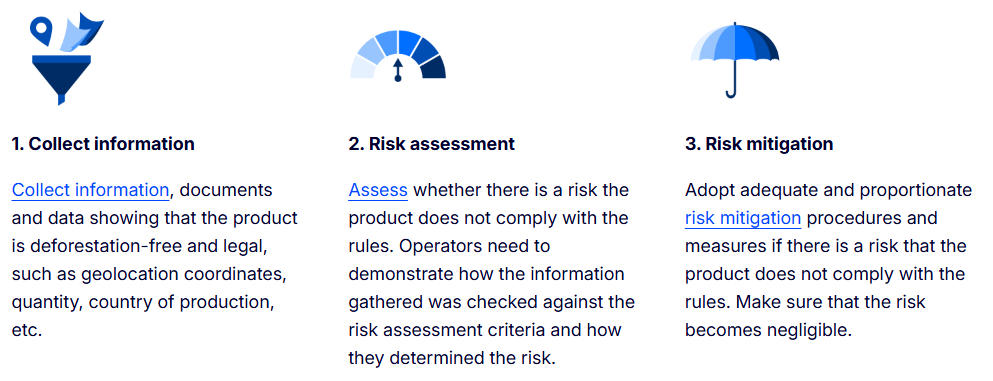 Source: European Commission
Operators sourcing commodities entirely from areas classified as low risk will be subject to simplified due diligence obligations. As a result, they are not required to fulfill the obligations for risk assessment and risk mitigation.
5.2 Due Diligence Statement
Operators, traders or their representatives shall register and submit a Due Diligence Statement (DDS) online through the Information System, prior to placing relevant products on the market or export them.
The required information include:
Operator/trader name and address
Activity type (import/export/domestic production/trade),
Harmonised System code, product name, product quantity
Country of origin and geolocation of all plots of land where the relevant commodities were produced
Reference number for the existing DDS (the system will assign one for the new DDS)
Affidavit
Signature
After submission, the Competent Authority will review and decide whether to consent or reject the DDS submission. After approval, the system will display the reference number that can then be used by the user to comply with the legal requirements.
For downstream operators, there is no need to check every single DDS upstream. Instead, they are subject to a minimum legal obligation of collecting DDS reference number from their suppliers and using those references for their own DDS submission. In addition, downstream operators shall also conduct due diligence investigation on their upstream suppliers to make sure legal compliance with EUDR.
Meanwhile, obligated entities are required to provide the documentation for risk assessment and risk mitigation upon request from the Competent Authority.
The due diligence process can be summarized below:

6. Our Services
As a professional service provider in EUDR compliance, we leverage our extensive experience and expert team to offer enterprises comprehensive support from compliance interpretation to practical implementation. We ensure your operations in the EU market are legal and compliant, steadily expanding your green trade business. Our services include:
EUDR Regulation Consulting
EUDR Regulation Training
EUDR Registration
EUDR Product Traceability and Supply Chain Due Diligence
EUDR Authorized Representative
EUDR Risk Assessment
FSC Forest Certification Consulting/Guidance
For more information, please contact [email protected].


