


On July 24, 2025, Japan's Ministry of Economy, Trade and Industry (METI) officially released environmental design certification standards for four categories of plastic products under the Design Guidelines for Plastic-Containing Products. Among them, PET bottles used for beverages were designated as one of the first eligible product types.
This certification system, established under the Act for Recycling Plastic Materials, allows competent ministers to recognize products with outstanding eco-friendly design. To obtain certification, enterprises must undergo a comprehensive evaluation, disclose relevant information, and meet the published standard. Certified products will be promoted under Japan’s Green Purchasing Law and may receive support for recycling infrastructure.
Key Design Standards:
1. Bottle
(1) Made solely from polyethylene terephthalate (PET), without the addition of any other substances. However, this does not apply if the bottles containing substances other than PET are safe, hygienic, and can be recycled.
(2) Not to be colored.
(3) The handle shall be made of uncolored PET or polyethylene (PE) or polypropylene (PP) with a specific gravity of less than 1.0.
(4) Nothing is to be printed on the bottle, except for the printing of minor labels such as expiration dates, manufacturer-specific codes, or lot numbers.
2. Label
(1) Polyvinyl chloride (PVC) is not to be used.
(2) Can be separated from the bottle during the recycling process, such as through air classification or washing.
(3) The printing ink used for the label must not adhere to the bottle.
(4) Cannot use labels that are laminated with aluminum (Al).
3. Cap
(1) Do not use Al or PVC.
(2) Must use PE or PP with a specific gravity of less than 1.0 as the main raw material.
(3) If glass marble or packing is used, the method of removal must be clearly indicated on the label.
4. Weight limit
PET bottles must be below the weight reduction standards established based on capacity and intended use.
(1) Aseptic use
[weight reduction standards for aseptic use] = 0.139×[capacity (ml)] + 14.2
(2) Pressure-resistant use
[weight reduction standards for pressure-resistant use] = 0.0136×[capacity (ml)] + 17.2
(3) Heat and pressure-resistant use
[weight reduction standards for heat and pressure-resistant use] = 0.0178×[capacity (ml)] + 17.7
(4) Heat-resistant use
[capacity (ml)] ≤ 500ml: [weight reduction standards for heat-resistant use] = 0.0164×[capacity (ml)] + 16.8
500ml < [capacity (ml)] ≤ 1500ml: [weight reduction standards for heat-resistant use] = 0.0235×[capacity (ml)] + 13.3
1500ml < [capacity (ml)]: [weight reduction standards for heat-resistant use] = 0.0098×[capacity (ml)] + 33.9
Notably, the percentage of the total weight of the relevant container consisting of the following materials must be 15% or more:
Recycled plastics conforming to JIS Q 14021 7・8・1・1 a) 1),
Recycled plastics conforming to JIS Q 14021 7・8・1・1 a) 2),
Biomass plastics (defined as plastics made from organic materials derived from living organisms, excluding fossil resources).
Design Certification Scheme:
To obtain design certification for plastic products, enterprises must apply to a government-designated inspection agency for a technical assessment of conformity with the Plastic Product Design Guidelines. Based on the submitted documents, the agency conducts the assessment and reports the results to the government, which then makes the final certification decision.
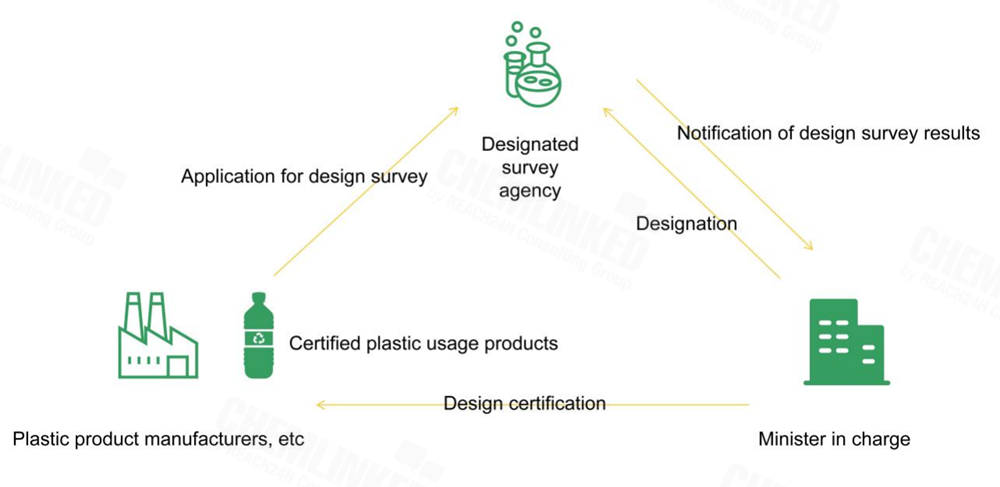
Under the design certification scheme, plastic products must meet safety, functionality, and other performance standards appropriate to their intended use. At the same time, when there is a trade-off between factors such as structural design and material selection, enterprises are required to conduct a comprehensive evaluation of environmental impact across the entire product life cycle.
Following certification, enterprises are also obligated to ensure transparency by proactively disclosing key information, including:
Product structure
Methods for disassembling parts
Material names of products and parts
Methods for replacing parts
Methods for repairing products and parts
Methods for crushing or incinerating products and parts
Methods for collecting and transporting products and parts
Precautions to ensure safety and reduce environmental impact during disposal
In addition, enterprises must establish an internal structure to ensure the accuracy and timely updating of such information. These requirements aim to facilitate informed decision-making by consumers and downstream recyclers, while promoting accountability in sustainable product design.